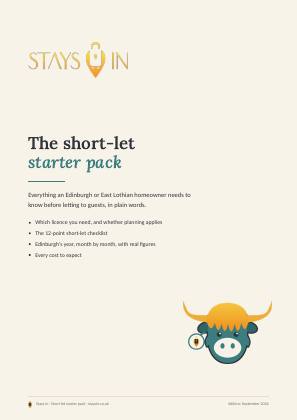

The short version is above. This is the longer read: how the scheme works, how to choose your route, what happens after you apply, and the mistakes we see Edinburgh owners make most often.
Short-term let licensing in Scotland: what the scheme covers
Scotland's short-let licensing scheme sits under the Civic Government (Scotland) Act 1982, the same law that covers other civic licences such as taxis and street traders. Each council runs it for its own area, so a flat in Leith is licensed by the City of Edinburgh Council and a house in North Berwick by East Lothian Council. The national rules are the same everywhere. Each council can add its own conditions and sets its own fees.
In plain words, a short let is accommodation in a home, or part of a home, that you let to guests who don't live there as their main home, in return for payment, as a business arrangement. That covers a whole flat on Airbnb, a spare room during the Fringe, a garden annexe and a family house let at Hogmanay. It doesn't matter which platform takes the booking, or whether you take bookings directly.
A private residential tenancy is a different thing entirely, with its own rules and protections for tenants. If you're weighing the two, our guide Short let or long let? The Edinburgh numbers compares them side by side.
Why it matters
Operating a short let without a licence or a valid exemption is a criminal offence. Platforms ask for your licence number, and the licence number and EPC rating must appear in every advert. It's the foundation everything else is built on: your listing, your insurance, your rates position and, in Edinburgh, your Visitor Levy returns.
The good news is that for most owners letting their own home, the process is clear once you know the route. The short-let glossary explains the terms you'll meet along the way, from "control area" to "Certificate of Lawfulness".
Choosing your licence route in three questions
The table above shows the four licence types and the temporary exemption. In practice, three questions settle which one you need.
- Do you live there? If the home is your only or main home, you're in home sharing or home letting territory. If you live somewhere else, it's secondary letting, and in Edinburgh that brings planning permission into play.
- Will you be there while guests stay? Guests in a spare room while you're at home is home sharing. The whole home let while you're away is home letting. If you'll do both at different times of year, one combined licence covers it.
- How many weeks a year? If you only want August, or August plus Hogmanay, a temporary exemption may be all you need: up to six weeks in a calendar year, in up to three periods.
Some common Edinburgh situations
- You live in a Bruntsfield tenement flat and travel for work several times a year: usually a home letting licence.
- You let a room to festival-goers every summer while you're at home: home sharing, or a temporary exemption if it's only a few weeks.
- You've moved abroad for good and kept the flat: this is likely secondary letting, not home letting. Read letting while you're away for work before you decide.
- You've inherited a flat and are deciding what to do with it: it isn't your main home, so secondary letting rules apply. Our guide Inherited a flat in Edinburgh? walks through the options.
If you're not sure which applies, the free plan asks the questions for you and tells you the route, the planning position and the costs for your home.
Planning and licensing in Edinburgh are two separate permissions
This is the point that catches most people out. A short-let licence and planning permission are two different things, decided by two different parts of the council, under two different laws. Having one doesn't give you the other.
The licence is about whether you and the home are fit to host guests safely. Planning is about whether the property can be used as a short let at all. Since 5 September 2022 the whole of Edinburgh has been a short-term let control area, which means using a whole home that isn't your main home as a short let is a change of use that needs planning permission.
How the two connect
When you apply for a secondary letting licence in Edinburgh, the council asks you to confirm your planning position: that you have planning permission, that you've applied for it, or why it isn't needed. The usual reason it isn't needed is a Certificate of Lawfulness, which shows the home was already lawfully used as a short let. Secondary letting and planning explains the evidence that usually takes.
For home sharing and home letting, planning is usually not needed, because letting your own home while you're away isn't normally a change of use. That's why we tend to start owners there when the home genuinely is their main home.
The order to do things in
- Confirm whether the home is your main home.
- If it isn't, settle the planning position first.
- Check your title deeds, factor rules, lender and insurer.
- Only then gather certificates and pay the licence fee.
The council doesn't refund the licence fee if the application is refused, so this order matters. Our Edinburgh rules page goes deeper into the control area.
What happens after you apply: the Edinburgh process, step by step
Once the application is in and the fee is paid, the council works through a set process. Knowing what's coming makes the wait easier.
- Site notice. You display a notice at or near the property for 21 days, so neighbours and passers-by know an application has been made.
- Objections and representations. Under the 1982 Act, people have 28 days from when the application is advertised to object in writing. An objection has to be signed, give the objector's name and address and explain the grounds. The council can accept a late objection if there's a good reason.
- Consultation. The council consults Police Scotland and the Scottish Fire and Rescue Service, who have a 28-day statutory consultation period.
- Inspection. Edinburgh inspects on a risk-based approach, so not every home is visited. Assume yours might be, and have everything ready from day one.
- Questions. The council may ask for more information or a corrected floor plan. Quick, clear answers keep things moving.
- Decision. The council aims to decide within about four months, and the legal maximum is nine. If anyone objects, you get a copy and the application goes to the council's Licensing Sub-Committee.
For a new application, you can't take guests until the licence is granted. Don't open your calendar, take deposits or promise dates to friends of friends before then. For a temporary exemption, applications can go in up to six months ahead, so a Fringe let means applying in early spring. The Fringe Host's Guide has the month-by-month version.
If you'd like us to prepare and submit it with you, our support fees are on the licence costs page.
Common licensing mistakes Edinburgh owners make
Most refused or delayed applications we hear about come down to a handful of avoidable mistakes. None of them are complicated. They're just easy to miss when you're doing this for the first time.
- Paying the fee before checking planning. For a home you don't live in, planning comes first. The licence fee isn't refunded if the application fails.
- Calling a second home a main home. The council looks at where you actually live: your council tax, your bank, the electoral register, where your life is. If you've moved out, it's secondary letting.
- Forgetting the lender and the title deeds. Many mortgages and some title deeds or factor rules restrict short lets. Check before you spend money.
- Insurance that doesn't cover short lets. A standard home policy usually won't. Your insurer needs to know.
- A floor plan that doesn't match the home. It must show the rooms, exits and alarms clearly and to scale.
- Listing before the licence is granted. For a new application, you can't take guests until it's granted.
- Letting the renewal date slip. A late application is only accepted with good cause, and after 28 days you start again.
- Forgetting the levy. In the City of Edinburgh, the Visitor Levy applies to stays from 24 July 2026, and hosts must register and file quarterly returns.
There's also a cost question that sits alongside the licence: whether your home pays council tax or business rates. It depends on how many nights it's available and actually let. Our page on council tax or business rates explains the 140/70 rule. The guide every Edinburgh host should read covers the rest.
Licensing support from Stays In, and where it stops
We prepare and submit home letting licences, home sharing licences, temporary exemptions and temporary licences with Edinburgh owners. That means checking the planning position, building the document pack and floor plan with you, booking any certificates you're missing, paying the council fee for you when we submit, answering the council's questions and tracking your renewal date.
We don't prepare secondary letting licence or planning applications. We do manage homes that already have planning permission and a secondary letting licence, and if planning isn't possible, we'll be honest about the alternatives.
Licence on its own, or with management
Licence support is available on its own, at the fees on our costs page. Many owners go on to have us look after the guests, pricing, cleaning, the Visitor Levy and the renewals as well. Our management fees are a percentage of net booking revenue, and the pricing page shows exactly what that means once VAT is added. Licensing support for managed homes is quoted in your plan.
Either way, the same small team does the work. Our three co-founders and a team of 17 are based in Edinburgh, and you can read more about who we are. Guests are answered from 9am to midnight, with an emergency line through the night, which also helps you meet the 24-hour contact condition.
Where to start
The simplest first step is the free plan. Tell us about your home and we'll send back your licence route, the planning position, every cost and what the home could earn on your dates. If you'd rather talk it through, book a 15-minute call with one of the co-founders. You can also see what your home could earn before you decide anything.
Still deciding which licence fits? Our post on home letting vs secondary letting walks through it step by step, and mortgage and insurance for short lets covers the permissions to sort first.

Book a 15-minute call with one of the co-founders, or get a free plan for your home: what it could earn, the licence route and every cost.